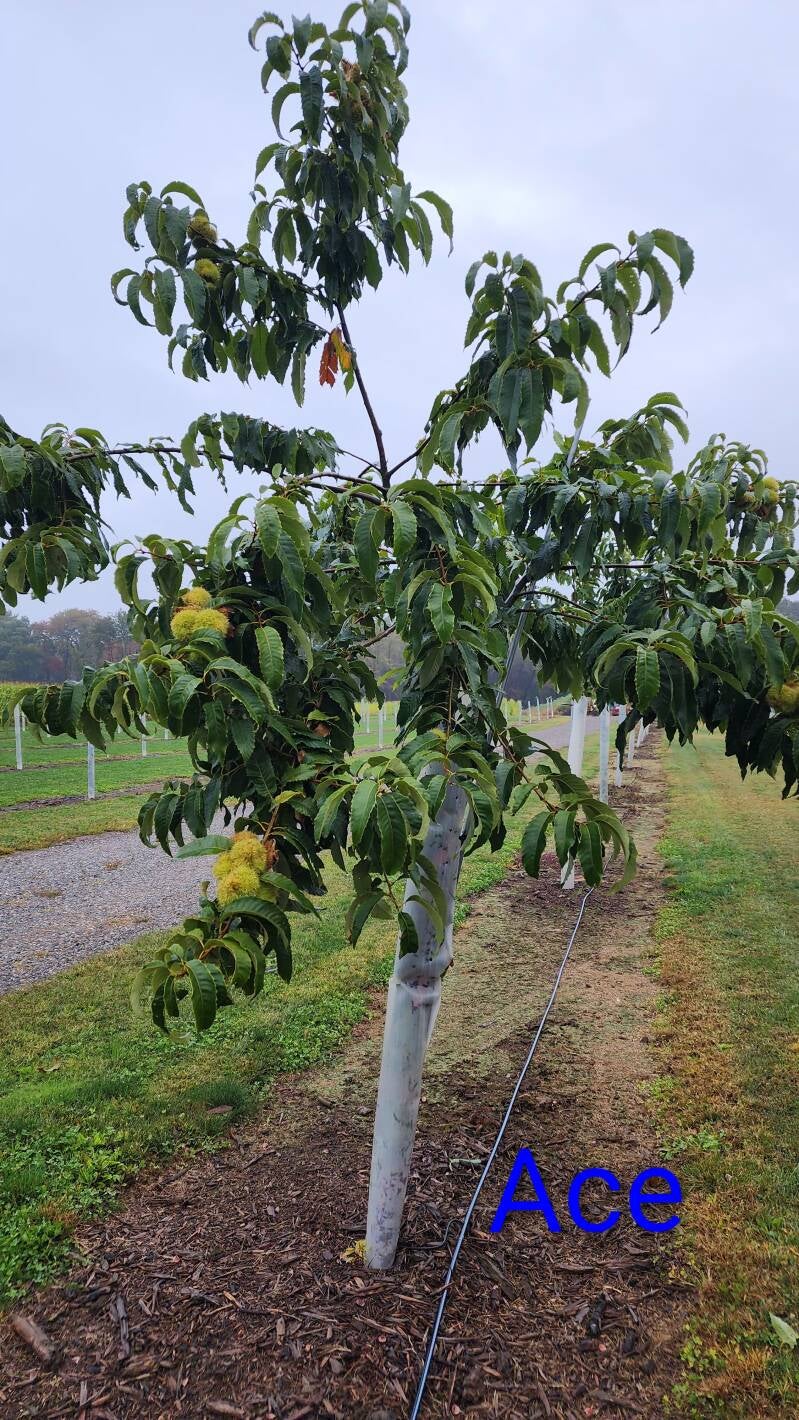
Ace
BRIEF:
A vigorous, heavily productive complex hybrid with easy-peeling nuts. Notable for two things: it takes pollen far more readily than it gives, and Japanese beetles seem to pass it over for other trees.
DETAILED:
Ace comes to us through Greg Miller's cooperative breeding program in Ohio, where it is one of twenty-three families with more than eight hundred trees planted across fifteen states. Michael Nave rates it as a valuable breeding parent — an extremely vigorous tree, heavily productive, with nuts that peel easily. It is a complex hybrid rather than a pure Chinese chestnut, and may carry all four major chestnut species in its background.
The interesting part is the pollen. The named Ace cultivar is male sterile: it produces catkins but no usable pollen, one of only two cultivars flagged that way in the breeding literature. Our trees are seedlings of Ace rather than copies of it, and how much pollen they produce is a live question. A grower in Michigan found only one seedling in twenty shedding. We have sixty trees and we are watching them closely.
What is clear is that Ace is unusually receptive on the female side — it accepts pollen across the whole flowering season, longer than anything else in the orchard. So it takes readily and gives little back, and we plant our pollen producers accordingly.
One more thing we have noticed, and other growers report the same: Japanese beetles seem to prefer other trees. We see occasional light feeding on Ace, but nothing like the damage elsewhere in the orchard.
New to growing chestnuts? Start here.
Choose Your Tree
Ace seed nuts will be available from specific trees in our orchard — pick the tree you'd like yours grown from below.
-
Coming soon
 Agnes (A-12) – Ace seed nuts US$0.00
 -
Coming soon
 Alma (A-26) – Ace seed nuts US$0.00