Seed nuts from Ace — Agnes (A-12)
The variety
Ace is one of the twenty-three families in Greg Miller's cooperative chestnut breeding program, which has put more than 12,500 trees in the ground across fifteen states. Ace itself is a complex hybrid rather than a pure Chinese chestnut, originally from California, and Michael Nave recommends it to eastern growers specifically as seedlings rather than grafted trees.
There is one oddity worth telling. The named Ace cultivar is male sterile — it makes no pollen at all, one of only two cultivars Miller flags that way. Our trees are seedlings of Ace, not clones of it, and in 2026 most of them shed pollen normally. That is what you would expect, since every one of our seedlings had a pollen-bearing father, but as far as we can find nobody has published on it. It is a small reminder that a seedling is its own tree, not a copy.
Agnes in 2026
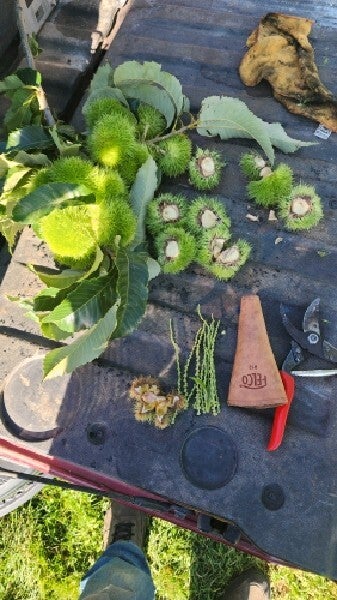
Agnes carried a heavy set this year. Branches bent past horizontal under the weight of the burs, and we tied them up to ten-foot conduit with polytape; one branch broke during the tying. Every bur we opened held developed kernels, often several to a bur — a sharp change from 2025, when this tree gave us mostly blanks.
The tree keeps its own clock. On a single September day we found mature burs, one fully opened bur with sound nuts still sitting in it, and fresh catkins on the branch tips. Bur size varies a good deal from one part of the tree to another. Green nuts sampled off the tree tasted unremarkable, which is what we expect — chestnut sugar arrives in cold storage, and we will taste them again then.
The tree
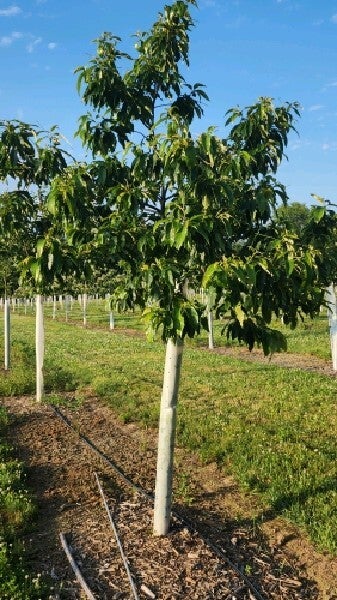
Agnes stands twelfth up row A, the westernmost row of the original planting, put in the ground on April 8, 2023. Row A is the upwind edge of the block, so it gets less pollen than trees standing deeper in the orchard; the rows that will eventually shelter and pollinate it are not yet bearing. Setting the crop it did this year, out on that edge, is worth knowing about it.